
News / Ball Python Pricing Strategy: Production Data v...
Ball Python Pricing Strategy: Production Data vs Sold Comps
- Marketplace comps tell you what buyers paid someone else. They do not tell you whether the sale was profitable for the seller.
- Production cost is your pricing floor. Feed costs, parent acquisition, substrate, shipping supplies. If you do not know this number, you are pricing blind.
- Internal data connects feeding records, sales, and production into real margin visibility per animal.
- THE RACK turns the data your program already generates into answers: cost per animal, margin per sale, ROI per breeder.
You already have the data you need to price your animals. Every feeding you log. Every pairing you plan. Every sale you close. The information exists inside your operation right now. The problem is not missing data. The problem is nothing is showing you what it means.
In This Guide
Here is what most breeders do when it is time to set a price. They open a marketplace, scroll sold listings for similar morphs, pick a number in the range, and post. It tells you what buyers paid someone else for something similar. It tells you nothing about whether the number covers what it cost you to produce and maintain the animal sitting in your rack.
Your breeding program is not someone else's business. Your feeder costs, your clutch sizes, your holdback timelines, your slow movers; all of it adds up to a production cost no marketplace listing will show you.
The Data Is Already There
Think about what you generate in a single breeding season. Feeding records. Pairing dates. Incubation logs. Hatch results. Sales. Every one of those events creates data. Most of it ends up in a notebook or spreadsheet and never gets looked at together.
The feeding records alone tell a massive story. What it costs to maintain each animal per month. Which holdbacks are accumulating cost faster than value. But a spreadsheet full of feeding dates does not calculate per-animal cost for you. The data exists. Nothing is connecting it to the decisions you need to make.
Production cost math in action
Here is a real scenario. You have a female on weekly feedings eating small rats at $3 each. She produces a clutch and you hold back four hatchlings on weekly feedings at $1.50 each.
Twelve weeks later, two hatchlings sell. The other two are still in the rack. In those twelve weeks, the four hatchlings cost you $72 in feeders. Mom ate another $36. Add the male's feed cost. You are at $120 or more in feed alone for a twelve-week window, and half the clutch has not sold.
Did the two sales cover the total production cost? Did they cover the ongoing feed for the two still sitting? If you do not know, you are pricing without seeing the floor. And the floor moves every week those remaining animals eat.
Want to see this math for every animal in your program?
Your production costs, calculated for you.
THE RACK ties every feeding to the animal and the cost. Sales analytics show your real margins, not marketplace guesses. See what your animals cost you before you set a price.
See Sales AnalyticsMarketplace Comps Tell You Half the Story
Sold comps are useful. Knowing what a morph combination moved for last month gives you a demand signal. No argument there. The problem is when comps become the entire pricing strategy.
A sold comp does not say what the seller spent to produce the animal. It does not say how long it sat before it sold or how many feeders went into it. Two breeders can sell the same morph at the same price and have completely different outcomes. One produced it from a proven female who threw a big clutch. The other produced it from a first-time breeder who threw three eggs after a full season of feeding. Same sale price. Completely different margins.
A sold comp tells you what buyers paid. Production data tells you what it cost you to get there. One is a reference point. The other is a business decision.
You already have the data.
Nothing is showing you what it means.
Internal Intelligence Changes How You Price
When you can see the cost side of every animal, pricing stops being a guessing game. You know your floor. You know which animals are generating margin and which ones are draining it.
Feeding logs tied to cost per feeder give you a running total on every animal. When a hatchling has been eating for ten weeks without a buyer, you can see the number climbing. You decide whether to adjust the price or wait, with the real number in front of you.
Sales analytics show your revenue next to your costs so the margin is visible on every sale. You can look back at a full season and see which pairings were profitable and which ones ate more than they earned. Comps tell you the market. Production data tells you your position in it.
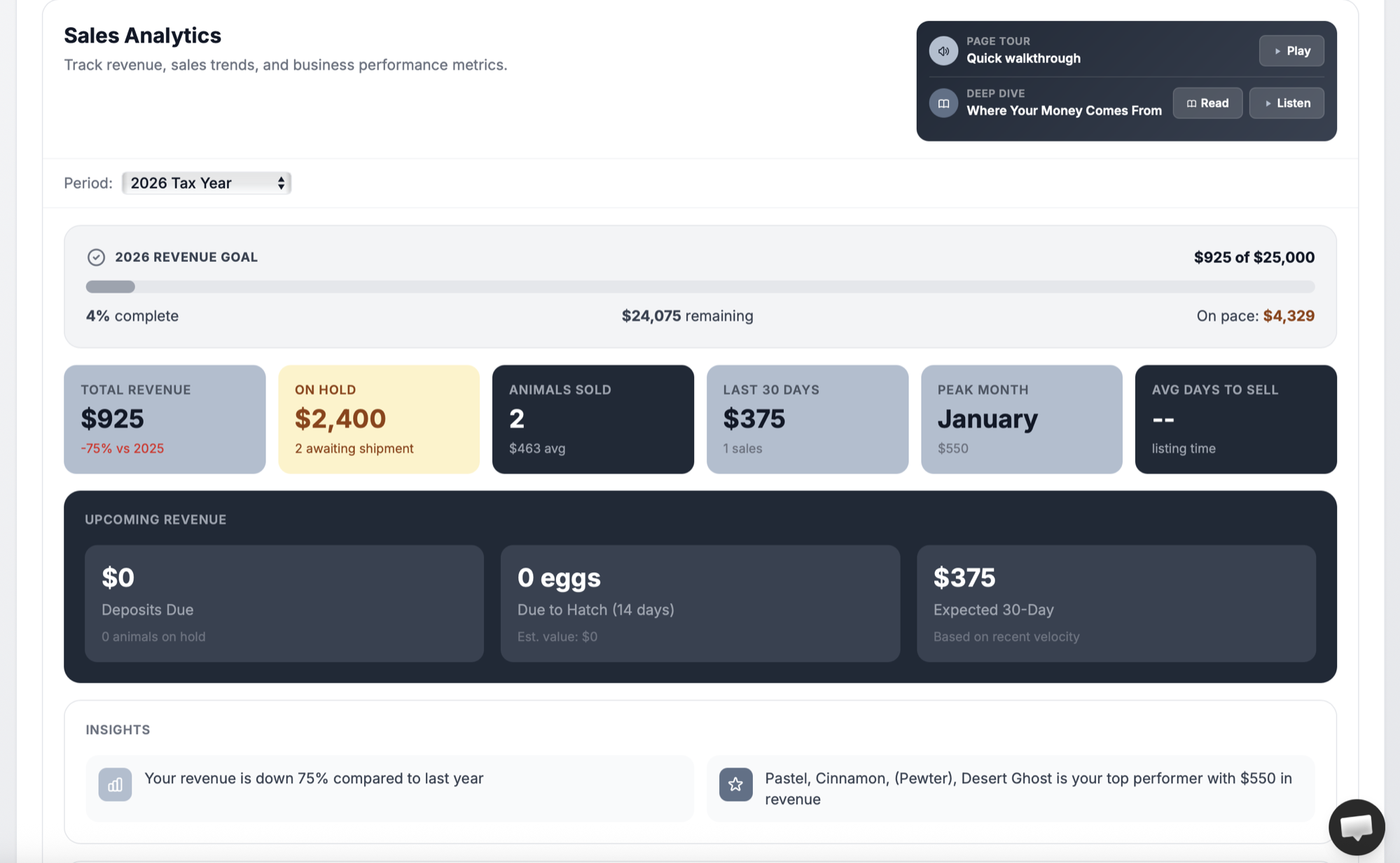
Want this view of your breeding program's finances?
See your real margins. Not marketplace guesses.
THE RACK connects your feeding costs, sales data, and production records into one view. Know your cost per animal. Know your margin per sale. Know your ROI per season.
See THE RACKROI Is Not a Number You Calculate Once
When you buy a high-value female, you have a number in your head for what she needs to produce before she pays for herself. Most breeders remember the purchase price and roughly count the offspring sales. What gets missed is the maintenance cost between those milestones.
She eats every week while she grows out, eats through conditioning, eats during follicle development, recovers after laying, and eats between clutches. Her offspring eat from hatch until they sell. All of those feeders chip away at the ROI number in your head. THE RACK shows ROI per animal with those costs factored in. You can see at any point whether a breeder has paid for herself or how far she still has to go.
Marketplace comps answer: "What are others charging?"
Production data answers: "Am I making money?"
Both matter. Only one runs your business.
You Do Not Need New Data
Every feeding, every pairing, every sale. You are already doing the work. The gap is not more data. The gap is a system connecting those records into something useful.
A feeding cost calculator turns your feeder expenses into per-animal numbers. Breeding logs tied to outcomes show you which pairings produce and which ones stall. Sales data with cost attached shows margin, not revenue.
This is what facility management software does. It takes the information your program already generates and turns it into answers. Cost per animal. Margin per sale. ROI per breeder. The data was always there. Now it means something.
Content verified against THE RACK breeding database. Production cost scenarios and sales analytics features confirmed against live breeder programs. Last reviewed April 2026.
Built by a Breeder
Stop scrolling comps.
Start seeing your margins.
Feeding costs per animal. Sales analytics with real margins. ROI per breeder. Production data your program already creates, turned into answers.
See THE RACKFree for up to 5 animals. Keeper $10/mo. Breeder $20/mo. 7-day money-back guarantee.